

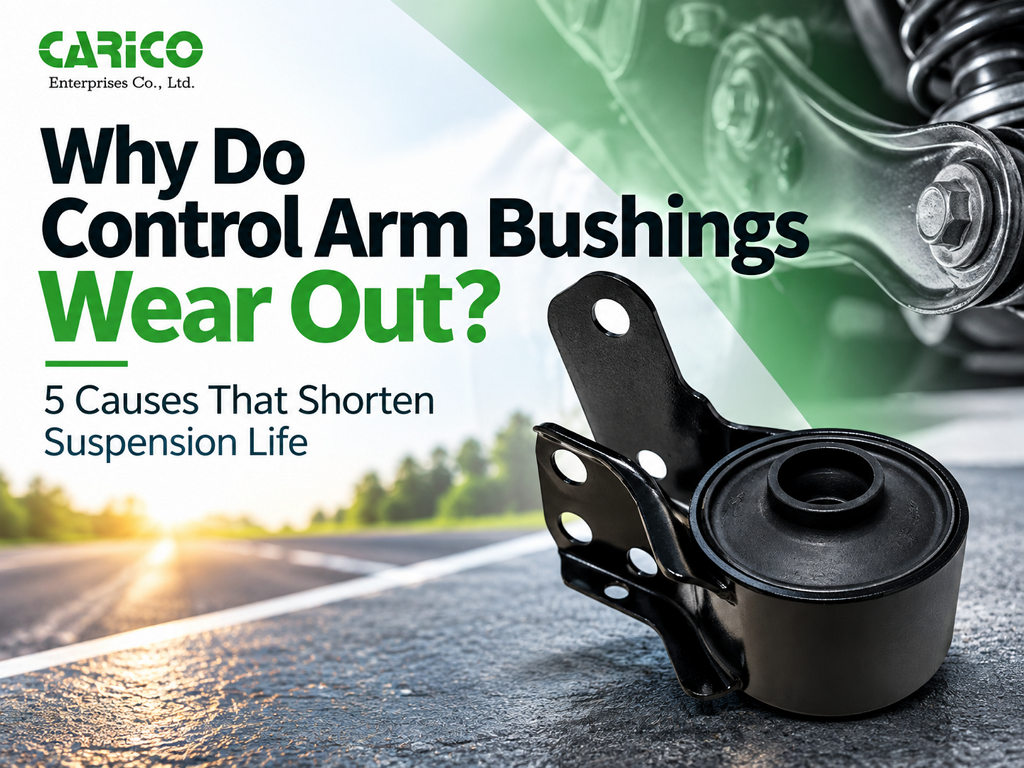
Control arm bushings may be small suspension components, but their condition can have a noticeable effect on ride comfort, steering response, wheel movement, and suspension stability. Positioned between the control arm and the vehicle mounting points, bushings help isolate vibration while allowing the control arm to move through its designed range.
Because they are repeatedly compressed, twisted, and exposed to road and environmental conditions, control arm bushings do not last indefinitely. Age is one factor, but premature wear can also result from harsh road impacts, contamination, excessive loads, and incorrect installation conditions.
Understanding why control arm bushings wear out can help vehicle owners, technicians, distributors, and replacement-parts buyers identify problems earlier, investigate the actual cause of premature wear, and select the correct replacement component.
What Does a Control Arm Bushing Do?
The control arm connects the vehicle chassis or subframe to the wheel-side suspension assembly. At its chassis mounting points, bushings provide a flexible interface between metal components.
Rather than creating a completely rigid connection, the bushing allows controlled suspension movement while helping absorb road shock, vibration, and noise.
A properly functioning control arm bushing helps:
- Isolate vibration between the wheel and vehicle body
- Allow controlled suspension movement
- Maintain the intended position of the control arm
- Support stable steering and handling
- Reduce noise and harshness transmitted through the chassis
As a bushing deteriorates, however, the control arm may gain more movement than intended. This can gradually affect suspension behavior and contribute to noise, unstable handling, alignment changes, or abnormal tire wear.
Understanding the cause of that deterioration is important because replacing a worn bushing without correcting the underlying problem may result in premature wear again.
1. Natural Aging and Repeated Flexing
Every time a vehicle accelerates, brakes, turns, or travels over an uneven surface, its suspension moves. The control arm bushing repeatedly deforms as part of this movement.
Over thousands of driving cycles, repeated flexing contributes to material fatigue.
Rubber bushings can gradually harden, crack, deform, or lose elasticity as they age. A bushing may therefore deteriorate even when the vehicle has not experienced a major suspension impact.
Vehicle age and mileage are useful indicators, but there is no single replacement interval that applies to every control arm bushing. Service life depends on vehicle design, material, driving conditions, environmental exposure, suspension loads, and maintenance.
Common Signs of Age-Related Deterioration
- Surface cracking in the rubber
- Hardened or brittle material
- Separation between rubber and the inner or outer sleeve
- Permanent deformation
- Excessive movement around the mounting point
Minor surface aging does not always mean immediate replacement is necessary. The more important question is whether the bushing can still control movement as intended.
Control arm bushings are continuously flexed during normal suspension operation. Material fatigue and aging gradually reduce their ability to isolate vibration and control suspension movement.
2. Potholes, Rough Roads, and Repeated Impact Loads
A control arm bushing is designed to accommodate normal suspension movement, but repeated severe impacts can accelerate wear.
Potholes, broken pavement, road debris, speed bumps taken at excessive speed, and frequent driving on rough surfaces can generate sudden forces through the wheel and suspension.
Those loads are transferred through components including the tire, wheel hub, steering knuckle, ball joint, control arm, and bushings.
A single impact does not necessarily destroy a bushing. The greater concern is repeated high-load cycling.
Over time, these impacts may contribute to:
- Rubber tearing
- Internal separation
- Permanent deformation
- Excessive bushing movement
- Damage to nearby suspension components
Vehicles regularly driven on poorly maintained roads or under demanding conditions may therefore require suspension inspection more frequently than vehicles operating primarily on smooth roads.
The bushing should also not be evaluated in isolation after a severe impact. The control arm, ball joint, wheel, tire, steering components, mounting points, and alignment may also need inspection.
Repeated road impacts increase the loads placed on control arm bushings. Severe or frequent impacts can accelerate deterioration and may also affect other suspension components.
3. Exposure to Oil, Heat, Water, and Environmental Contaminants
Control arm bushings operate underneath the vehicle, where they are exposed to a challenging environment.
Depending on the vehicle and bushing location, the component may encounter water, dirt, road salt, oil, grease, heat, and repeated temperature changes.
These conditions can affect bushing materials differently.
Petroleum-based fluids may degrade certain rubber compounds. Heat can accelerate material aging, while repeated temperature cycles can contribute to hardening and loss of elasticity. Moisture and road salt may also promote corrosion around metal sleeves, mounting bolts, and surrounding suspension components.
An oil leak near a suspension bushing should therefore not simply be cleaned away during service. The source of the leak should also be identified and corrected where appropriate.
When inspecting a contaminated bushing, technicians should look for:
- Swelling or softening
- Cracks
- Surface deterioration
- Separation from the sleeve
- Corrosion around mounting hardware
- Abnormal deformation
Control arm bushings are exposed to more than mechanical loads. Oil, heat, moisture, road salt, and other contaminants can accelerate material deterioration and affect surrounding mounting components.
Related Reading: 4 Maintenance Tips to Extend the Life of Your Lower Control Arm Bushing
4. Heavy Loads and Demanding Driving Conditions
Vehicle load directly influences the forces handled by the suspension system.
Frequent operation near the vehicle's maximum permitted load, commercial use, repeated heavy cargo, towing where permitted by the vehicle manufacturer, and other demanding operating conditions can increase stress on suspension components.
When the suspension moves under greater loads, control arm bushings must manage higher forces while continuing to control the arm's position.
The effect can become more significant when heavy loading is combined with rough roads, frequent braking, acceleration, or repeated suspension movement.
This does not mean that carrying a heavy load automatically damages a bushing. Suspension components are designed around specified vehicle operating conditions. Problems become more likely when loads exceed those specifications or demanding conditions are repeated over a long period.
For commercial or high-use vehicles, suspension inspection should therefore consider actual operating conditions rather than mileage alone.
Higher and repeated suspension loads can increase bushing stress. Vehicle load limits and actual operating conditions should be considered when evaluating expected suspension-component life.
5. Incorrect Installation or Suspension Geometry Problems
Not every prematurely worn control arm bushing fails because of the bushing material itself.
Installation conditions can have a major influence on service life.
Many conventional bonded rubber bushings are designed to twist within a specific working range as the suspension moves. Depending on the suspension design and manufacturer procedure, tightening mounting bolts while the suspension is hanging may place the rubber in an unintended preloaded position once the vehicle returns to normal ride height.
This can subject the bushing to continuous torsional stress even when the vehicle is stationary.
Correct installation procedures are therefore important. Technicians should follow the vehicle manufacturer's specified tightening sequence, torque values, and suspension-position requirements.
Premature wear may also be associated with:
- Bent control arms
- Damaged mounting points
- Incorrectly installed components
- Worn ball joints or other suspension parts
- Abnormal ride height
- Previous collision damage
- Incorrect wheel alignment
- Unresolved suspension geometry problems
If a newly installed bushing fails unusually quickly, replacing it again without investigating the surrounding suspension may simply repeat the problem.
Premature bushing failure can be a symptom rather than the root cause. Installation position, torque procedures, control-arm condition, mounting points, and overall suspension geometry should all be checked.
What Are the Signs of Worn Control Arm Bushings?
Bushing deterioration is not always immediately noticeable. Wear usually progresses gradually, and similar symptoms can also be caused by ball joints, tie rod ends, stabilizer links, wheel bearings, tires, or other chassis components.
Possible signs include:
- Clunking or knocking over bumps
- Increased vibration or harshness
- Less precise steering response
- Vehicle wandering or instability
- Abnormal movement during braking or acceleration
- Uneven or accelerated tire wear
- Visible cracks, tearing, or separation in the bushing
These symptoms should be treated as reasons for inspection rather than proof that a particular control arm bushing has failed.
A technician should inspect the complete suspension system before determining which component requires replacement.
Should You Replace Only the Bushing or the Complete Control Arm?
The correct replacement strategy depends on the vehicle and the design and condition of the control arm assembly.
Some control arm bushings are available and serviceable separately. In other applications, replacing the complete control arm assembly may be more appropriate because of the component design, condition of the arm, integrated components, labor requirements, or vehicle manufacturer's service procedure.
Before choosing a replacement, consider:
| Inspection Point | Why It Matters |
|---|---|
| Bushing condition | Determines whether deterioration is isolated to the bushing. |
| Control arm condition | Bent, cracked, heavily corroded, or damaged arms may require complete replacement. |
| Ball joint condition | Excessive play or other damage may indicate additional replacement needs. |
| Mounting points | Damaged mounting surfaces can affect installation and component life. |
| Vehicle application | Bushing and control arm designs vary by make, model, year, and suspension configuration. |
| OE/reference number | Helps identify the correct replacement application. |
Replacing components based only on appearance or vehicle mileage can lead to unnecessary repairs or incorrect component selection.
Related Reading: When Should You Replace the Control Arm or Just the Ball Joint?
How Can Control Arm Bushing Life Be Extended?
Normal wear cannot be eliminated, but several practices can help reduce avoidable deterioration.
Inspect suspension components periodically, particularly when the vehicle frequently operates on rough roads or under demanding loads. Repair fluid leaks that may contaminate rubber components. Avoid severe pothole impacts where safely possible, and do not exceed the vehicle manufacturer's load limits.
Correct installation is equally important. Replacement bushings or control arms should be installed according to the applicable vehicle service procedure, including specified torque values and suspension position during final tightening where required.
After suspension repairs, wheel alignment should also be checked when specified by the vehicle manufacturer or when suspension geometry may have been affected.
Regular inspection is particularly useful because early deterioration may be easier to identify before excessive movement begins to affect other suspension components.
Choosing the Correct Control Arm Bushing for the Vehicle
A replacement bushing must match the specific suspension application.
Physical appearance alone is not enough because similar-looking bushings may have different dimensions, material characteristics, sleeve designs, mounting positions, or vehicle applications.
Before sourcing a replacement control arm bushing, buyers should confirm information such as:
- Vehicle make
- Vehicle model
- Model generation
- Model year
- Installation position
- OEM reference number, when available
- Required quantity
- Supplier reference number
Accurate application data reduces the risk of ordering a component that appears similar but does not match the suspension design.
Material is another consideration. Rubber and polyurethane bushings have different characteristics, and the appropriate choice depends on the vehicle application and intended operating requirements.
Related Reading: Lower Control Arm Bushing: Comparing Rubber and Polyurethane Materials
CARICO Control Arm Bushings for Different Vehicle Applications
CARICO supplies control arm bushings as part of its suspension system product range, covering a wide range of vehicle makes and applications.
CARICO's online product information allows buyers to identify components using application details such as car make, car model, model year, CH number, OEM reference where available, and mounting description.
This application-based approach is particularly important for control arm bushings because products that look similar externally are not necessarily interchangeable.
For aftermarket distributors, auto parts buyers, and repair professionals, providing accurate vehicle and reference information can make product identification more efficient and reduce the risk of selecting an incorrect suspension component.
Conclusion
Control arm bushings wear because they operate at the intersection of movement, vibration, impact, load, and environmental exposure.
Five major factors can accelerate deterioration:
- Natural aging and repeated flexing
- Potholes, rough roads, and repeated impacts
- Oil, heat, water, and environmental contaminants
- Heavy loads and demanding driving conditions
- Incorrect installation or suspension geometry problems
When a bushing wears earlier than expected, simply replacing the component may not solve the underlying issue. The control arm, ball joint, mounting points, surrounding suspension components, operating conditions, and installation procedure should also be considered.
Identifying the cause of wear and selecting the correct replacement for the specific vehicle application can help restore the intended suspension function while reducing the risk of repeated premature failure.
For aftermarket distributors, repair professionals, and auto parts buyers looking for control arm bushings for specific vehicle applications, CARICO provides suspension components covering a broad range of vehicle makes and models.
Looking for the Correct Control Arm Bushing?
Contact CARICO with your vehicle information, CH number, or OEM reference number to identify a suitable suspension component for your requirements.
Contact UsFAQ
Can worn control arm bushings cause uneven tire wear?
They can contribute to abnormal tire wear if excessive bushing movement allows suspension geometry to change beyond its intended range. However, uneven tire wear can have many causes, including incorrect alignment, tire pressure, worn ball joints, steering components, or other suspension problems. A complete inspection is important before determining the cause.
Can I replace a control arm bushing without replacing the control arm?
It depends on the vehicle and control arm design. Some bushings are serviceable separately, while other applications may make complete control arm replacement more practical or necessary. The condition of the control arm, ball joint, mounting points, and the vehicle manufacturer's service procedure should all be considered before deciding which component to replace.
Why did my new control arm bushing wear out quickly?
Premature wear may result from incorrect installation, tightening at an inappropriate suspension position, damaged mounting points, a bent control arm, abnormal suspension geometry, severe operating conditions, contamination, or an incorrect replacement part. If a recently replaced bushing fails unusually quickly, the surrounding suspension should be inspected to identify the underlying cause.